
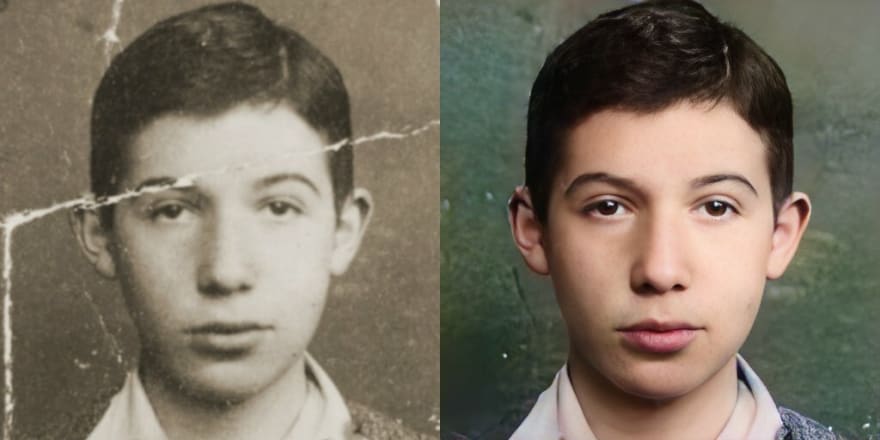
The memories captured in old photos are true treasures, but time can wear them down, leaving them faded or damaged. Fortunately, with today's technology, it's possible to restore these images and bring back their original colors and details. Today, there are several high-quality photo restoration apps available for download on the Play Store, which use artificial intelligence (AI) to facilitate the process.
Plus, many of these apps allow you to download them directly to your phone for free, offering advanced features at no additional cost. If you're looking for a practical solution to recover old photos, know that tools like these are at your fingertips. So, keep reading to discover the best apps for editing old photos and how they can transform your memories into HD.
How Do Old Photo Recovery Apps Work?
Essentially, high-quality photo restoration apps use advanced AI algorithms. This technology analyzes the image's pixels and fills in damaged or faded areas, resulting in a refreshed photo. Additionally, many of these apps offer additional features, such as contrast adjustment and blemish removal, to ensure even more impressive results.
On the other hand, it's important to note that not all apps are created equal. Some require a paid download, while others allow for free downloads from the Play Store. Therefore, when choosing an app, be sure to check whether it meets your needs before downloading.
Remini
One of the most popular apps for restoring old photos in high quality is Remini. This app uses advanced AI to enhance old photos and make them sharp again. With just a few clicks, you can download it for free from the Play Store and start using its powerful features. Its intuitive interface makes it easy for anyone to use.
Additionally, Remini offers premium options that allow access to more advanced editing tools. Even so, the free version is sufficient for those looking to recover old or faded photos. Therefore, this app is an excellent choice for those seeking practicality and efficiency.
PhotoScan
PhotoScan, developed by Google, is another great option among apps for restoring old photos in high quality. It allows you to scan your physical photos directly to your phone, preserving their original quality. After downloading the app from the Play Store, you can store your memories in an organized and secure way.
Another advantage of PhotoScan is that it eliminates reflections and distortions during the scanning process. This makes your old photos even sharper and ready to share. With so many advantages, it's no wonder this app is widely recommended by experts.
Snapseed
Snapseed is a versatile app that can also be used to restore old photos in high quality. Available for download on the Play Store, it offers a variety of editing tools that allow you to correct colors, adjust brightness, and even remove imperfections. Plus, its user-friendly interface makes the process simple and quick.
While some prior knowledge is required to explore all its features, Snapseed is perfect for those who want complete control over editing. Therefore, it stands out as an excellent alternative for enhancing old photos and bringing your memories back to life.
Pixlr
If you're looking for an easy-to-use app to restore faded photos on your phone, Pixlr is a great choice. After downloading it for free from the Play Store, you'll have access to automatic filters and manual tools that help revitalize your images. Pixlr also offers built-in tutorials to make learning easier.
Another unique feature of this app is its ability to work with different file formats, allowing you to save your edited photos in high resolution. This makes it a practical and reliable option for those who want to recover old photos without hassle.
EnhanceFox
EnhanceFox is one of the best apps for restoring images, especially when it comes to severely damaged photos. By downloading it now from the Play Store, you'll have access to advanced features. IA that automatically enhance the details of your photos. The app also offers a free version with basic features, ideal for beginners.
On the other hand, if you need more professional features, the paid version of EnhanceFox is worth it. It includes additional options, such as sharpening and noise removal, which ensure even more impressive results. Therefore, this app is an excellent choice for those who want to transform their memories into HD.
Conclusion
With so many options available, it's clear that high-quality photo restoration apps are practical and efficient solutions. From Remini to EnhanceFox, each app mentioned in this article offers unique features that can meet your specific needs. So, if you want to recover old or faded photos, simply download them for free from the Play Store and try these incredible tools.
Finally, remember that technology is here to help us preserve our memories. So, don't waste any time and start exploring the best apps for restoring old photos in high quality today. Download now and see how your images can gain new life!
What does automatic restore do?
Restoring an old photo using an app involves three distinct operations, and it's important to know which one you need:
- Increased resolution. A model trained on millions of images reconstructs plausible detail from what exists. Faces usually improve significantly because there are many examples of faces in the training.
- Scratch and stain removal, filling in the damaged area based on the surroundings.
- Colorization from a black and white photo, with colors estimated by context.
The point that changes the outcome: the capture.
The final quality depends more on how you scan than on the application. Photographing an old portrait with your cell phone in hand, under ceiling light, throws away half of what could have been salvaged.
- Indirect natural light, near a window, out of direct sunlight.
- Cell phone parallel to the photo, so as not to distort the perspective.
- No flash — it creates a reflection on the glossy paper.
- Remove the glass from the picture frame. Reflection is the most difficult defect to remove later.
- Frame only the photo., as close as possible, to use all the pixels of the sensor.
The honest limit of technology
This is the point that separates expectation from frustration: reconstruction. invent a plausible detail, It doesn't restore what was lost. On a very small or severely damaged face, the result may be noticeable but also different from the person—softened features, altered eye shape.
Therefore, the following recommendation is appropriate: save the original file. The restored version is an interpretation; the original is the recording.
Frequently Asked Questions
Is the color of the coloring the true color?
No. It's an estimate based on context. Vegetation and sky are usually accurate; clothing and objects are guesswork.
Why did the face become "plastic"?
The model is overly smoothed. Several apps have intensity controls—reducing them usually gives a more natural result.
Do I need to pay?
The most common limitation of the free plan is exporting at reduced resolution or with a watermark.
Is it possible to repair a photo that's torn in half?
If both parts exist, merge them in an editor first. Autocomplete works best on small errors.