
Running out of mobile data while on the street is undoubtedly one of the most common frustrations of modern life. Whether it's hailing a ride, responding to an urgent message, or simply finding an address on a map, the dependence on the connection is total. Consequently, many find themselves forced to sign up for increasingly expensive data plans, which, however, don't always last the entire month. Fortunately, there's a universe of free Wi-Fi connections all around us, in cafes, squares, shopping malls, and airports, just waiting to be used. The big question is: how can we find them quickly and safely?
The answer is in the palm of your hand, more specifically, in applications developed for this purpose. These tools act as a guide, mapping millions of free internet access points around the world, many of them with passwords shared by a global community of users. So if you're wondering what is the best app for free wifi, this article is your definitive guide. In it, we'll take a detailed look at the two giants in this market, showing how they work, their strengths and weaknesses, and, above all, how to use them to stay connected without using up your data plan and, of course, with complete security.
Why use an app to find free Wi-Fi?
Before we dive into the apps, it's crucial to understand the practical benefits they offer. After all, the idea of free internet is appealing, but the benefits go far beyond simple savings.
Firstly, the most obvious benefit is the mobile data savingsBy using public Wi-Fi hotspots for bandwidth-intensive tasks like watching videos or making video calls, you preserve your data allowance for times when there's really no other option. Second, these apps offer a unparalleled convenienceInstead of asking for the password at each establishment, you have access to a huge database with information updated by the community itself, allowing for a quick and hassle-free connection.
Furthermore, for travelers, these tools are simply indispensable, as they eliminate the need to buy expensive local SIM cards or pay for international roaming packages. Many apps even offer offline maps, allowing you to find hotspots even if you're completely without a signal. Finally, they also promote discovery. By searching for a hotspot, you might, for example, find a charming new cafe or a public library you hadn't heard of, encouraging you to explore your own city.
Top 2 Free Wi-Fi Apps in Detail
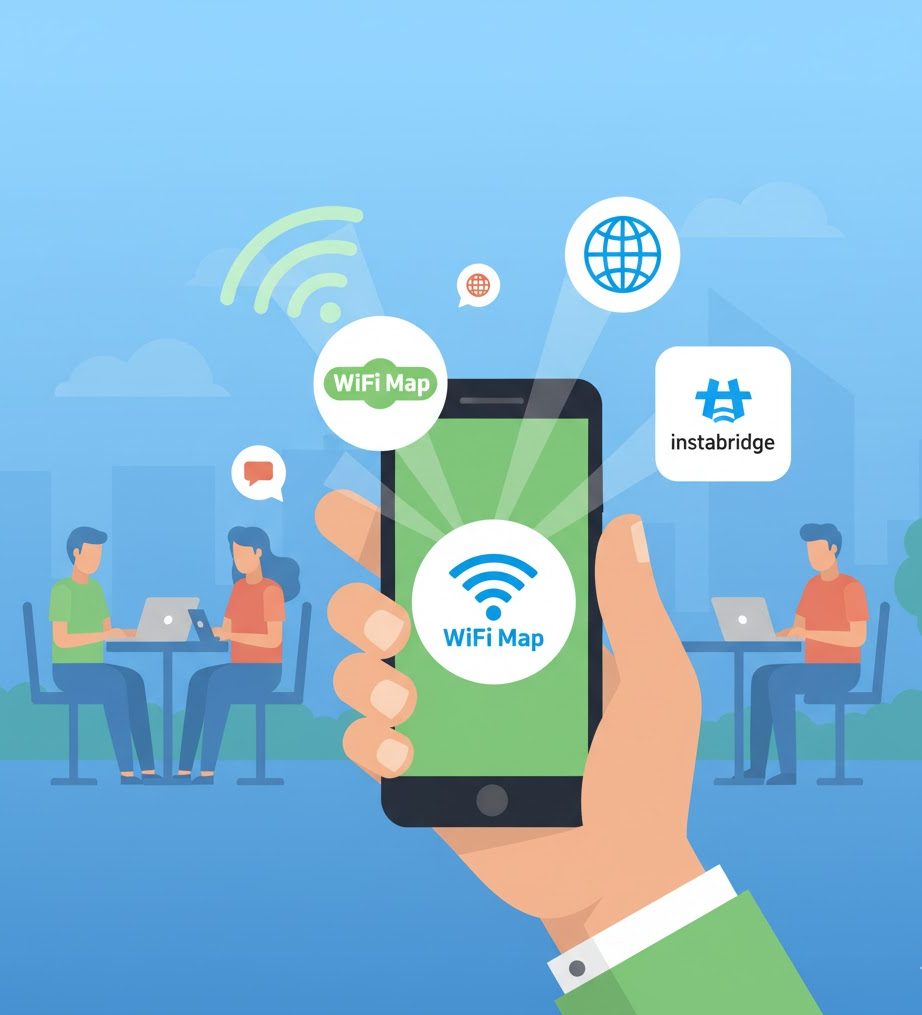
The Wi-Fi app market is vast, but two stand out for their popularity, community size, and robust functionality: WiFi Map and Instabridge. Both deliver on the promise of connecting users to free networks, but they do so with slightly different approaches and features. So, let's analyze each to help you decide. what is the best app for free wifi to your profile.
WiFi Map: The Collaborative Password Map
WiFi Map is undoubtedly the most popular app in this category. Its premise is simple yet powerful: a collaborative platform where millions of users add and update Wi-Fi hotspots and their passwords around the world. The result is a global map with over 150 million hotspots.

WiFi Map: Free Wi-Fi Access
AndroidWhen you open the app, it uses your GPS location to display a map with all registered access points around you. You can then tap on any point to see details such as the network name, signal quality, and password. WiFi Map's strength lies precisely in the power of its community. In other words, the more people collaborate, the more accurate and useful the map becomes.
Main Features and Resources
- Interactive Map: The main feature is, in fact, the map, which allows you to visually explore hotspots. It can also be viewed in list format.
- Offline Maps: This is a crucial resource for travelers. It allows you to download a map of an entire city to consult even when you're offline.
- Integrated VPN: Aware of the risks, WiFi Map offers a (paid) VPN service to encrypt your connection and, consequently, protect your data.
- Speed Test: A useful tool to check the quality of your connection before you start using it, thus avoiding slow and unstable networks.
- and yes: A newer feature that allows you to purchase mobile data packages directly through the app, functioning as a virtual SIM card for travel.
Advantages and Disadvantages of WiFi Map
In short, the pros include its massive database, offline maps, and additional features. On the other hand, the downsides are that many advanced features require a paid subscription, and password accuracy can vary, as it depends on user collaboration.
Instabridge: Simple One-Touch Connection
Instabridge, on the other hand, positions itself as the simplest way to connect to Wi-Fi networks. Its biggest differentiator is its pursuit of automation. The idea is that, once you're within range of a registered network, your phone connects to it automatically, without you even needing to open the app.
Instabridge: WiFi Password
AndroidLike WiFi Map, Instabridge is community-driven. The difference lies primarily in the user experience. It works in the background, identifying networks from its database and connecting your device without manual intervention. It also shows you which networks work based on feedback from others, saving you time.
Key Features and Differentiators
- Automatic Connection: Without a doubt, its most notable feature as it eliminates the manual process of connecting.
- Offline Maps: Like its competitor, it allows you to download Wi-Fi lists by city for access without internet.
- Secure Browser: The app comes with its own browser that consumes less data and has privacy features.
- Usage Statistics: Provides data on how much you've saved on your data plan, a great way to visualize the benefit.
- User Ranking: It also gamifies the experience, encouraging users to add more networks to climb the rankings.
Instabridge Strengths and Weaknesses
In short, its strengths are its extreme ease of use, the convenience of automatic connection, and the fact that it's free. However, its database may be smaller in some regions, and the automatic function may occasionally connect to low-quality networks.
How to Use These Apps Safely?
The convenience of free Wi-Fi anywhere comes with a responsibility: protecting your data. Public networks are, by nature, less secure. They can be targeted by attacks where a cybercriminal intercepts your data. Fortunately, with a few precautions, it's possible to drastically minimize these risks.
1. Use a VPN: First and foremost, this is the most important tip. A VPN creates an encrypted "tunnel" for your connection, making your data unreadable to anyone trying to intercept it.
2. Check “HTTPS”: When browsing, always check if the website address starts with https:// and displays a padlock. This indicates that the connection to that site is encrypted, adding an extra layer of security.
3. Avoid Sensitive Transactions: As a general rule, avoid accessing your bank or making online purchases on a public network. Leave these activities for a secure connection, such as your home connection or your mobile data connection.
4. Disable Auto Connect: In your smartphone's settings, disable the option to automatically connect to open networks. This prevents your device from connecting to fake networks without your permission.
5. Keep Your Software Updated: Finally, make sure your phone's operating system and apps are always up to date, as updates often fix important security flaws.
Conclusion: What is the verdict?
So after all this analysis, what is the best app for free wifi? The truth is that there is no single winner, but rather the app that best suits your needs.
If you are an avid traveler who needs a global database and values the ability to download maps of entire countries, WiFi Map will probably be your best choice. On the other hand, if you're looking for maximum convenience in your day-to-day life and value the simplicity of automatic connection, Instabridge will certainly please you more.
Regardless of your choice, both apps excel in their mission of democratizing internet access. The most important thing, however, is to use them responsibly, always following the security tips to ensure your experience is not only free but also secure.
I connected, the icon filled up, and no page opens.
The phone connected to the network, the Wi-Fi icon appeared fully visible, and the browser keeps spinning. Before blaming the app that indicated the hotspot, look at the... captive portalThe login screen that shopping malls, airports, hotels, bus stations, and coffee shops place between the customer and the internet is the number one cause of "connected but nothing opens.".
The router provides a network address as soon as you tap on the network name, which is why the icon lights up. But traffic is blocked until you accept the terms or enter an email address. This screen should open automatically, but it often doesn't: the window disappears when the system has already marked that network as validated on a previous visit, or when the browser tries to go directly to an encrypted address.
The sequence that makes the login screen appear.
- Enter an address in
http://, without the "s". The encrypted address cannot be intercepted by the portal, and the browser displays a certificate error instead of the form. The unencrypted connection is the one the portal can intercept, and it is this connection that pulls up the login screen. - Turn off your VPN before logging in. VPN and private DNS block this authentication because they divert traffic from the path where the portal makes the diversion. Turn it back on after browsing is restored.
- Disable private DNS. in the network settings, for the same reason.
- Open an incognito tab. The browser saves the portal's old response and serves a copy.
- Forget about the network and connect again. Negotiations resume and the warning usually returns.
The limits of any public network
A full signal doesn't mean a fast connection. The signal icon measures intensity, not speed: it indicates the radio strength between the cell phone and the router, and says nothing about the bandwidth reaching that point or how many people are sharing it at the same time. In a crowded food court, four bars yield less than one bar in an empty library.
- Session with a deadline. Many websites drop the connection after 30 or 60 minutes and require a new login.
- Services blocked. Some networks allow browsing but disable video calls, online gaming, and corporate VPNs.
- Registration is required. Name, email, and sometimes CPF (Brazilian tax identification number): access is paid for with personal data, and this data often ends up as a mailing list.
- Someone else's password is out. An application that promises to reveal a neighbor's network password commits the crime described in article 154-A of the Penal Code, and this type of program is a known vector for malware.
Frequently Asked Questions
I accepted the portal, but the website still won't open. What now?
Some networks release traffic a few seconds after confirmation. Wait and reload the page. If the problem persists only in one application, it is likely that that service is blocked by the network.
Can I use a VPN on a public network?
It can, and is recommended to, do so after logging in. During authentication, it interferes because it prevents redirection to the portal. The correct procedure is to connect, authenticate, and then activate the VPN.
The app shows the network, but it doesn't appear on the phone.
The registration information might be outdated: the location may have changed the network name or turned off the router. Collaborative networks age quickly, and no one notifies you when a hotspot goes offline.